
The digital marketing world has entered a new era where Google isn’t the only gateway to discovery. AI assistants, chatbots, and generative search engines now decide which businesses show up when customers ask questions.
If your content doesn’t surface in ChatGPT, Gemini, Perplexity, or SGE results, you’re invisible to a fast-growing segment of digital searchers.
Enter the AEO–AIO–GEO framework. It’s a four-layer system that helps your brand earn AI citations and search visibility across both human and machine audiences. For businesses leaning into digital transformation, this is the evolution of SEO rooted in structure, semantics, and strategy that drives results.
The Four Layers: AEO, AIO, GEO, and SXO in Context
Traditional SEO is no longer enough for businesses that want to succeed in 2025 and beyond. You need a content strategy that aligns with how AI interprets and delivers information.
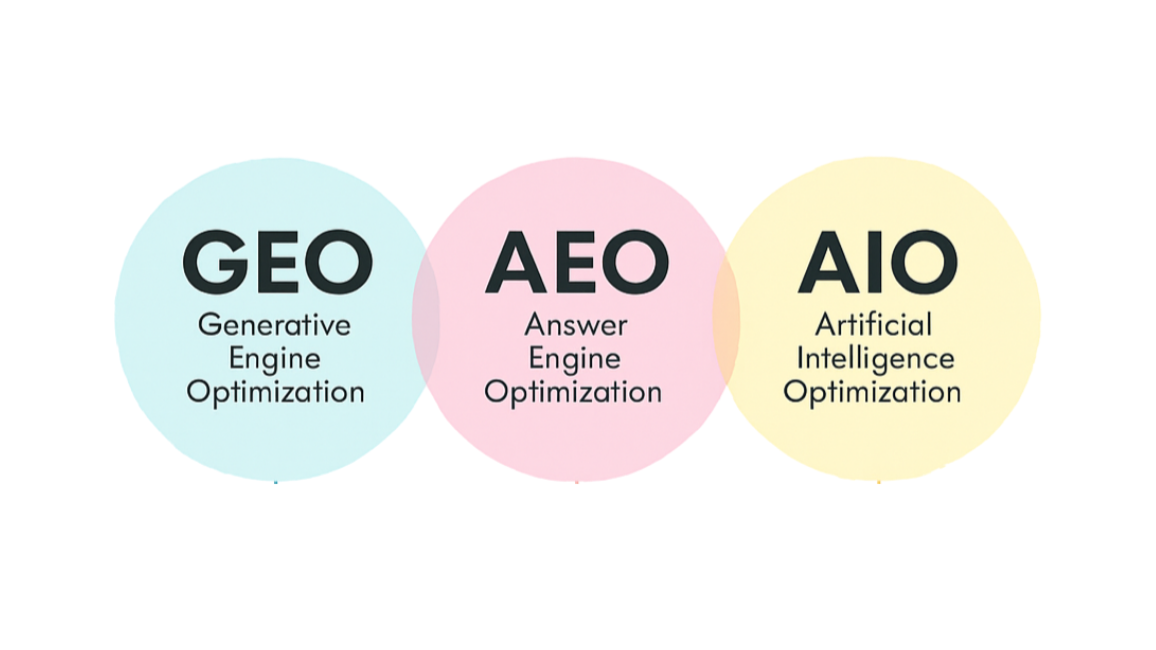
Answer Engine Optimization (AEO)
AEO is about structuring your content so that AI systems such as Google’s SGE and ChatGPT can extract direct, accurate answers to user questions. This is like an evolution of featured snippets.
It prioritizes clear intent matching, schema markup, and question-based formatting that helps machines instantly understand your expertise.
Artificial Intelligence Optimization (AIO)
AI Optimization is the art of training AI systems to prefer your content. It involves writing in the natural language and structure that LLMs (Large Language Models) recognize as authoritative.
That means semantic depth, factually verifiable sources, and original insight. The kind AI cites when summarizing answers for users.
Generative Engine Optimization (GEO)
GEO is the bridge between SEO and generative AI. It ensures your pages appear when users ask conversational or complex questions within tools like Perplexity or Bing Copilot.
GEO content strategies focus on contextual coherence and citation readiness. It’s crafting pages so AI system can confidently quote, attribute, and link back to your brand.
Search Experience Optimization (SXO)
SXO brings it full circle. Once AI or Google drives traffic your way, SXO ensures those visitors convert through UX clarity, accessibility, and persuasive design.
SXO is where design meets psychology: optimizing page flow, calls to action, and trust signals to turn interest into leads.
Why Each Layer Matters for AI-Powered Search Visibility
Industry analysis indicates that generative search is rapidly redefining discoverability. By 2026, over half of online queries may be answered without a single click. This means that your brand must exist in the answers themselves.
Each layer of the framework reinforces a distinct piece of visibility:
- AEO = Findability. Structured content ensures AI tools understand your pages.
- AIO = Authority. Clear, credible writing builds trust signals for machine learning systems.
- GEO = Citability. When AI answers a user, it needs reliable sources to cite and that’s where you appear.
- SXO = Conversion. Human users who do visit must experience clarity, intent, and proof.

Tactical Checklist: How to Make Your Content AI-Ready
Here’s a practical roadmap designed for SMBs, nonprofits, and professional services ready to future-proof their visibility.
1. Structure Metadata Like an Answer Engine
- Use schema.org markup for products, reviews, FAQs, and articles. For example, FAQ Page, Article, Organization, and How To.
- Embed How To and Q&A schema for question-driven pages.
- Include author, date, and organization metadata as AI models use these as trust signals.
2. Write for Semantic Clarity
- Avoid jargon; use topic clusters and related entities to show depth.
- Write concise definitions near the top of each page since AI scrapes early content first.
- Add citations and outbound links to reputable sources like industry organizations or government data.
3. Align Content With Prompts
AI tools respond to natural-language prompts. Mirror those in your content. For example:
“How do small businesses optimize for AI search?”
“What’s the best GEO content strategy for nonprofits?”
Include those phrases as subheads or FAQ sections. You’re literally speaking AI’s language.
4. Optimize for GEO
- Ensure your brand name, expertise, and location appear naturally across your content.
- Publish context-rich pages.
- Use internal linking to clarify topical relevance.
5. Audit UX and Conversion Flow (SXO)
Even the most AI-visible pages fail if visitors bounce.
Audit for:
- Page load under 2.5 seconds.
- Readable typography and mobile responsiveness.
- Clear CTAs.
- Social proof and outcome-driven language.
At KPH Digital, we call this “Performance by Design.” You’re combining structure and story to drive measurable results.
How to Audit Your Content for GEO Readiness
Before creating new pages, assess where you stand today. Here’s how to run a GEO content audit in four steps:
- Search AI Tools for Your Brand. Ask ChatGPT, Gemini, or Perplexity:
“Which agencies offer full-funnel marketing in St. Louis?”
Do you appear? If not, you’re invisible to the new search layer. - Evaluate Entity Recognition. Does your site use structured data that helps AI know what your company is (agency, brand, nonprofit)? Tools like Google’s Rich Results Test can verify that.
- Check Semantic Coverage. Review your top service pages. Are you covering the “why,” “how,” and “who” behind your offerings? AI prefers depth over density.
- Benchmark Citations and Mentions. Search for your company name in quotation marks within generative platforms or AI-summarized results. Over time, track when and where your content gets referenced.
Real Results: Businesses That Boosted AI Visibility by 30–40%
Several brands have already seen the payoff of adopting an AEO-AIO-GEO approach.
Professional Services Firm
A mid-sized accounting practice restructured its FAQ and services content around AEO principles. Within three months, ChatGPT began referencing its tax strategy guides in responses. Their traffic from AI-linked searches rose 37%.
Regional Event Venue
By implementing GEO-focused metadata (event name, location, amenities, and pricing) and writing conversational copy that mirrored how users ask questions, the venue gained inclusion in Bing Copilot listings. Bookings increased 32% quarter-over-quarter.
Nonprofit Organization
A community nonprofit used KPH Digital’s framework to combine AIO clarity and SXO storytelling. Its volunteer recruitment page became one of the top AI-cited examples for “local volunteer programs in St. Louis,” driving consistent inquiries and donations.
Why Human-Centered Content Still Wins
AI can summarize data but it can’t replicate experience. The best-performing AEO, AIO, and GEO content still comes from real expertise expressed clearly and confidently.
That’s why human-authored storytelling remains the foundation of visibility. When you pair authentic insights with structured clarity, AI systems amplify your credibility rather than replace it.
In other words: AI doesn’t just find any content. It finds the best-explained content.
And that’s where your brand has an edge. SMBs, nonprofits, and professional services that invest in this structured, human-centered approach will dominate both traditional and AI-driven discovery.
Final Thoughts
Ask yourself if your content strategy is future ready. The future of visibility isn’t about chasing algorithms; it’s about earning authority in every layer of the search ecosystem.
By integrating AEO, AIO, GEO, and SXO, you’re not just optimizing for clicks but also for credibility and connection.
At KPH Digital, we help growing organizations translate complex strategy into performance marketing that actually works. Because in the age of AI search, marketing that means business starts with content AI can trust and users want to act on.